
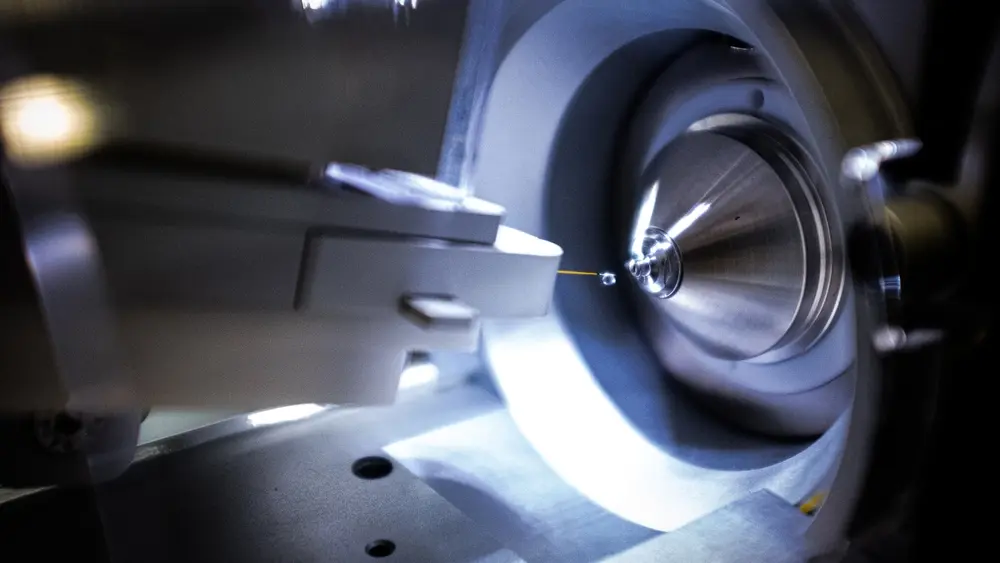
Mass spectrometry (MS) is one of the most powerful analytical tools used for pharmaceutical testing and characterization. Through the application of MS, laboratories can identify, quantify, and characterize compounds. This is essential for detecting impurities, monitoring degradation over time, understanding how a drug breaks down in the body, and supporting a wide range of pharmaceutical testing needs.
Mass spectrometry works by converting molecules in a sample into gas-phase ions and measuring their mass-to-charge ratio (m/z). Depending on the technique, molecules can be ionized using an electron beam, an electrical field, or other forms of energy, producing positively or negatively charged ions.
The ions then enter a mass analyzer, where they are separated according to their mass-to-charge ratios before reaching a detector. The resulting signals are processed to generate a mass spectrum, which displays ion intensity as a function of mass-to-charge ratio.
Because different compounds produce characteristic mass spectral patterns, scientists can use this information to help identify unknown compounds, quantify known compounds, and gain insight into molecular composition and structure.
Within mass spectrometry, there are two key ionization methods that are employed frequently in the pharmaceutical sector. Gas Chromatography-Mass Spectrometry (GC-MS) was developed in the 1970s, with Inductively Coupled Plasma-Mass Spectrometry (ICP-MS) coming later in the 1980s. Although each technique serves important purposes in pharmaceutical development and testing, they come with their own advantages and disadvantages. BA Sciences offers the expertise and capabilities to provide both approaches, helping life sciences clients select the method best suited to their specific analytical needs.
How ICP-MS and GC-MS Approach the Same Process Differently
Both processes are forms of mass spectrometry, but they follow different approaches to achieve the same result. In ICP-MS, the sample to be analyzed is nebulized into an aerosol form, after which it is exposed to a high-temperature argon plasma reaching up to 10,000 degrees Kelvin. This atomizes and ionizes the sample, and it is in that state that the ions are directed to the mass analyzer to be separated by mass-to-charge ratio. Once measured, this provides a breakdown of the concentration of each detected element found in the sample.
On the other hand, GC-MS uses an inert gas such as helium or nitrogen to carry the vaporized sample through a heated column. Once inside the column, the sample interacts with it, causing the compounds contained in the sample to travel at different speeds. After they leave the column, the compounds undergo electron bombardment inside the mass spectrometer to induce ionization. The resulting ions are accelerated into the mass analyzer to be separated based on their mass-to-charge ratio. Comparing the graph that results to libraries of known compounds provides the researchers with accurate identification of the sample’s chemical makeup.
Examining the Pros and Cons of Each Technique
ICP-MS and GC-MS each offer distinct strengths and limitations based on their underlying analytical principles and applications. ICP-MS, for example, excels at detecting and measuring trace levels of elements with high sensitivity. It provides higher sensitivity, with detection limits that reach parts per trillion for a wide range of elements. It’s also very effective at detecting a broad spectrum of elements. However, a key limitation of ICP-MS is its limited ability to provide structural information, making it less suitable for the characterization of organic compounds.
In contrast, GC-MS is particularly well suited for analyzing organic compounds, providing valuable structural information that can help scientists identify specific compounds within complex samples. However, GC-MS generally does not achieve the same level of elemental trace detection as ICP-MS, making ICP-MS the preferred technique for detecting and quantifying elements at extremely low concentrations.
Other Key Differentiators Between ICP-MS and GC-MS
Beyond their detection ranges, there are a number of key distinctions between each MS technique that may factor into the decisions made by laboratories when choosing an approach. Here is a brief overview of how each method differs in some important areas:
| ICP-MS | GC-MS | |
|---|---|---|
| Analysis Speed | Capable of processing multiple samples at the same time, speeding up analysis | Chromatographic separation process requires longer run times, but can result in a greater amount of structural data. |
| Data Complexity | Elemental concentration data is relatively easy to understand, making interpreting the information simpler | More-complex findings require detailed interpretation that calls for more expertise, but also provides more detail regarding molecular composition |
| Sample Preparation Methods | Organic and biological samples must be completely digested before analysis, which can result in certain details about molecular structure to be lost | Extraction and derivatization are necessary steps prior to analysis, which can slow down the process |
| Cost Considerations | Platforms based on ICP-MS typically have higher upfront costs, maintenance costs, and operating costs due to the use of plasma | Generally less expensive to operate than ICP-MS |
Work with BA Sciences for Complete Expertise
As one of the leading providers of analytical services for the pharmaceutical industry, BA Sciences has the expertise and capabilities needed to provide clients with the testing and analysis that provides the best fit for their needs. Since 1987, we have worked with countless life sciences companies to deliver comprehensive services that help them solve their biggest challenges.
Our extensive analytical capabilities, advanced facilities, and experienced scientific team make BA Sciences a trusted partner to pharmaceutical and life sciences companies nationwide. Just as importantly, we take a personalized approach to every client engagement. Each project is supported by a dedicated project manager who serves as a primary point of contact, working closely with the client to develop an approach tailored to their specific needs and helping ensure the project is executed efficiently and effectively
Our comprehensive range of services includes mass spectrometry, and we are intimately familiar with ICP-MS, GC-MS, and other technologies. Working with BA Sciences means clients benefit from our expertise, helping them select the approach that will deliver the desired results and help them keep their projects on track. When companies in the pharmaceutical sector need to be sure about the quality, efficacy, identity, and regulatory compliance of their products, they turn to BA Sciences.
If you’re in the market for mass spectrometry services that will deliver the best possible results for you and your next pharmaceutical development project, look no further than BA Sciences. Reach out and speak with a member of our qualified staff today to learn more about everything we can do to support you and your efforts.