FTIR Testing Services for Pharmaceutical Material Identification

Fourier transform infrared spectroscopy (FTIR) provides pharmaceutical, biotechnology, and medical device companies with a rapid and reliable approach to material identification, characterization, and the evaluation of chemical composition. BA Sciences offers FTIR testing to support regulated programs, combining experienced scientific analysis with clear documentation and responsive client support.

Our scientists use FTIR for raw material identification, product characterization, quality control, and investigations. We help you define the testing strategy and understand what the spectrum means for your project.

What Is FTIR Testing?

FTIR is an analytical technique that measures how a material interacts with and absorbs infrared radiation. When infrared energy corresponds to specific molecular vibrations, it produces characteristic absorption bands that provide information about the functional groups and chemical structure of a sample.

FTIR is widely used for chemical fingerprinting, as many materials produce distinctive infrared spectra that can aid in identification and comparison. Analysts can compare a sample spectrum with a qualified reference material, compendial standard, known material, or spectral library to help confirm identity, characterize materials, or investigate chemical differences.

FTIR analysis commonly focuses on the mid-infrared region, approximately 4000 to 400 cm⁻¹, although the specific range may vary depending on the instrument and analytical method. FTIR is frequently used for qualitative identification and comparison, but it can also support quantitative analysis when an appropriate method and validated calibration model are established.

How Fourier Transform Infrared Spectroscopy Works

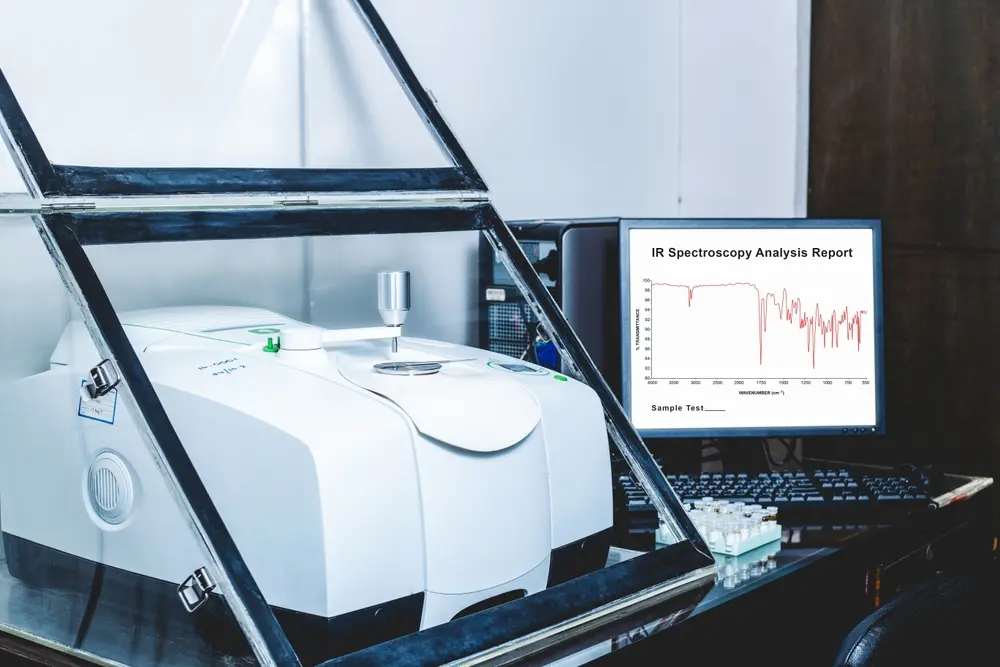
An FTIR spectrometer directs infrared radiation through an optical system, typically using a Michelson interferometer to collect information across a range of infrared frequencies. The instrument generates an interferogram, which is converted through a mathematical Fourier transform into an infrared spectrum that displays absorption as a function of wavenumber.

By measuring a broad range of infrared frequencies simultaneously, FTIR can collect spectral data relatively quickly. While an individual scan may take only minutes once the sample and instrument are prepared, the overall project timeline also accounts for sample preparation, spectral comparison, data review, and reporting.

FTIR Sampling Approaches

FTIR is an analytical technique that measures how a material interacts with and absorbs infrared radiation. When infrared energy corresponds to specific molecular vibrations, it produces characteristic absorption bands that provide information about the functional groups and chemical structure of a sample.

FTIR is widely used for chemical fingerprinting, as many materials produce distinctive infrared spectra that can aid in identification and comparison. Analysts can compare a sample spectrum with a qualified reference material, compendial standard, known material, or spectral library to help confirm identity, characterize materials, or investigate chemical differences.

FTIR analysis commonly focuses on the mid-infrared region, approximately 4000 to 400 cm⁻¹, although the specific range may vary depending on the instrument and analytical method. FTIR is frequently used for qualitative identification and comparison, but it can also support quantitative analysis when an appropriate method and validated calibration model are established.

Pharmaceutical FTIR Testing Applications

FTIR can provide useful information throughout pharmaceutical development and manufacturing, especially for identity comparisons and initial assessments of chemical composition.

Raw Material, API, and Excipient Identification

FTIR raw material identification compares an incoming material with an appropriate reference. It can help confirm APIs, excipients, and other manufacturing inputs before use and reveal meaningful differences from the expected material. BA Sciences supports pharmaceutical raw material programs involving compendial and non-compendial requirements.

Product Characterization and Material Comparisons

FTIR analysis services can support formulation, process development, manufacturing investigations, and product characterization. Analysts can use FTIR to compare materials across suppliers or lots, evaluate changes before and after processing, and investigate chemical differences that may occur following storage or environmental exposure.

FTIR can be used to evaluate changes associated with oxidation, degradation, or shifts in functional groups. While differences in a spectrum can indicate that a material has changed, additional investigation may be needed to determine the underlying cause and assess its potential impact on the product.

Contamination and Investigational Analysis

FTIR may help characterize unexpected particles, residues, films, and foreign materials when enough representative sample is available. Analysts can compare the spectrum with known materials or libraries to develop an identification or narrow the possibilities.

Library matching works best for relatively pure materials with distinctive spectra. Complex mixtures, small samples, overlapping bands, and low-level components may not produce a conclusive match, making experienced review essential.

Medical Device and Packaging Materials

Pharmaceutical and medical device programs may use FTIR to compare polymers, films, coatings, elastomers, and other materials. It may also help characterize a residue or particle during a broader extractables and leachables investigation, but it does not replace a complete study.

How FTIR Results Are Interpreted

Analysts consider absorption-band position, shape, relative intensity, and the overall fingerprint region. They may compare the sample with a reference collected under equivalent conditions, a qualified stored spectrum, or a library.

Interpretation requires more than accepting the first software match. Preparation, surface condition, moisture, concentration, solid-state form, and instrument settings can affect a spectrum. A dominant material may also mask minor components.

BA Sciences evaluates the full spectrum and study purpose before drawing conclusions. Reports may include sample identification, the procedure, relevant spectra, comparison results, observations, and an interpretation. Deliverables are established during scoping.

USP <197> and Compendial Identity Testing

USP <197> describes spectroscopic identification tests used to confirm chemical identity when referenced by an applicable monograph. Infrared identification commonly compares a test sample with the corresponding USP Reference Standard under equivalent conditions.

BA Sciences can review the method, sample, specification, reference-standard requirements, and verification history. If no suitable compendial procedure exists, a non-compendial method may need development or validation.

FTIR testing is not automatically compliant with USP <197>. Suitability depends on the applicable monograph, procedure, controls, references, and documentation.

FTIR Limitations and Complementary Methods

FTIR is a strong first-line technique for bulk material identification, but it is not the best standalone answer for every sample. Detection depends on the matrix, target, sampling approach, spectrum quality, and band overlap. Trace components and unknown mixtures can be difficult to identify reliably.

Orthogonal techniques can enhance separation and sensitivity depending on the material and analytical need. GC-MS is well suited for volatile and semi-volatile compounds, while LC-MS can detect separable, nonvolatile compounds at lower levels. Raman spectroscopy can provide complementary characterization for certain materials, although fluorescence may interfere with analysis.

BA Sciences can assess whether FTIR alone is suitable or a broader analytical approach is warranted.

FTIR Method Development, Verification, and Validation

A transferred or compendial FTIR procedure may require feasibility work or verification before routine use. A new application may require development and fit-for-purpose validation. Work can include selecting the sampling approach, establishing measurement parameters, defining references, and setting spectral acceptance criteria.

Validation characteristics depend on whether the method is qualitative or quantitative and may include specificity, precision, accuracy, linearity, range, and robustness. The documentation package is defined by the project and quality requirements.

BA Sciences is happy to provide analytical development and validation support across pharmaceutical programs.

FTIR Testing in CMC and Quality Workflows

FTIR data can support CMC activities including material identification, formulation and process investigations, supplier or lot comparisons, stability assessments, and defined release tests supported by an appropriate method and specification.

BA Sciences reviews the product, development phase, regulatory objective, methods, specifications, sample availability, and schedule to design work around the decision the client needs to make.

Early planning also clarifies whether the program requires a compendial identity test, a direct material comparison, an investigational screen, or a newly developed procedure. Establishing the intended use before testing helps align the method, acceptance criteria, documentation, and review process with the broader pharmaceutical program.

Turnaround, Cost, and Project Deliverables

How long FTIR testing takes depends on sample count and type, preparation, method status, references, comparisons, quality requirements, and reporting. Data acquisition is often fast, but verification, method development, investigations, and complex interpretation require more time. BA Sciences establishes the schedule after reviewing the scope.

FTIR test cost varies with sample count, material type, preparation, method development or verification, standards, repeat testing, interpretation, and reporting. A focused identity comparison differs from an unknown-material investigation or validated quantitative method.

Providing the sample type, objective, method, specification, deliverables, and required date helps BA Sciences prepare an accurate quote and realistic schedule.

Why Choose BA Sciences for FTIR Analysis Services?

For 40 years, BA Sciences has supported life science companies throughout the product lifecycle, combining deep scientific expertise with responsive communication, flexible planning, and the agility to meet the demands of time-sensitive pharmaceutical programs.

BA Sciences is a cGMP-compliant, FDA-registered, and DEA-licensed laboratory. Maintaining ISO/IEC 17025:2017 accreditation for defined testing activities, including microbial count testing on water, pharmaceutical products, and raw materials.

Clients work closely with experienced scientists and a dedicated project manager throughout each program. Clear, step-by-step methods help streamline execution and facilitate efficient method transfer, while comprehensive reporting delivers results with clarity, accuracy, and precision.

Frequently Asked Questions About FTIR Testing

How Is an FTIR Test Performed?
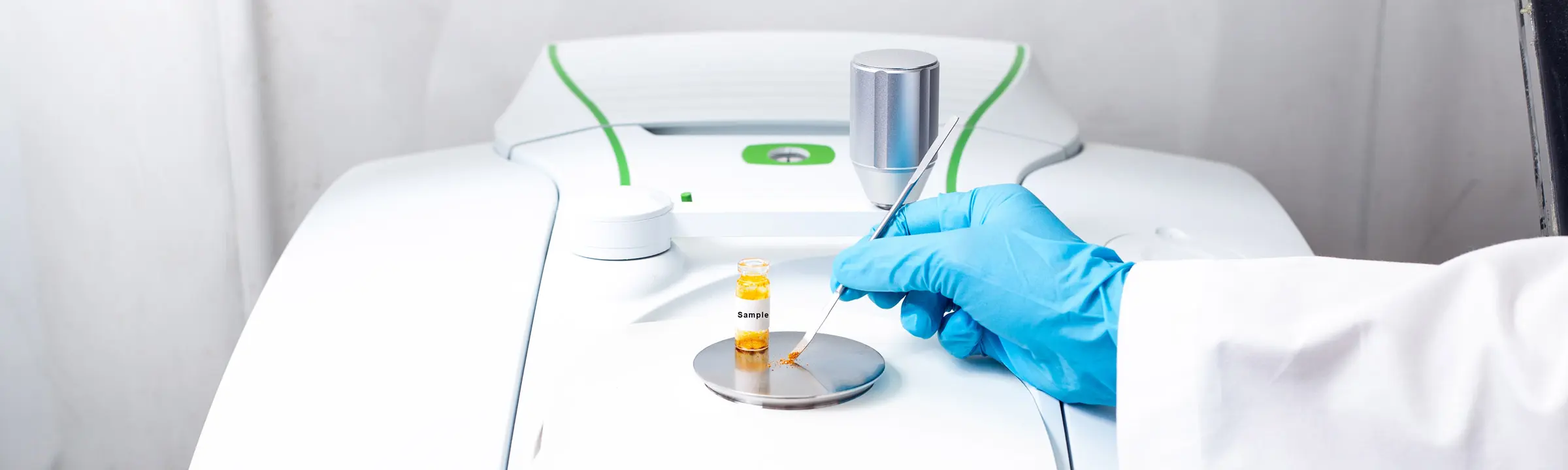
The laboratory defines the objective, reviews the sample, chooses a sampling technique, and collects a spectrum under controlled conditions. An analyst evaluates it against a reference, specification, comparison sample, or library.

How Do I Interpret My FTIR Results?
Interpretation considers characteristic bands and the overall fingerprint. Unexpected bands, shifts, or intensity differences may indicate another material, a physical-form difference, contamination, degradation, or a preparation effect. The result must be evaluated within the project context.

How Small a Particle Can FTIR Analyze?
Minimum particle size depends on the instrument configuration, sampling technique, material, and amount available. Provide photographs, estimated dimensions, collection method, and background so BA Sciences can assess feasibility.

Can FTIR Be Quantitative?
Yes, when the application has a suitable calibration, standards, sensitivity, and validated method. Many pharmaceutical FTIR applications are qualitative identity or comparison tests.

How Do I Request FTIR Testing from BA Sciences?
Provide the material, analytical question, sample count, known hazards, applicable method or specification, and desired timeline. Then, request an accurate, timely quote

Discuss Your Pharmaceutical FTIR Testing Project

Connect with BA Sciences to discuss your raw material testing, product characterization, investigation, or quality control needs. Our team will work with you to define the appropriate scope, determine documentation requirements, and develop a testing strategy aligned with your development and manufacturing priorities.

Ready to get started? Tell us about your upcoming project

Tell Us About Your Project