
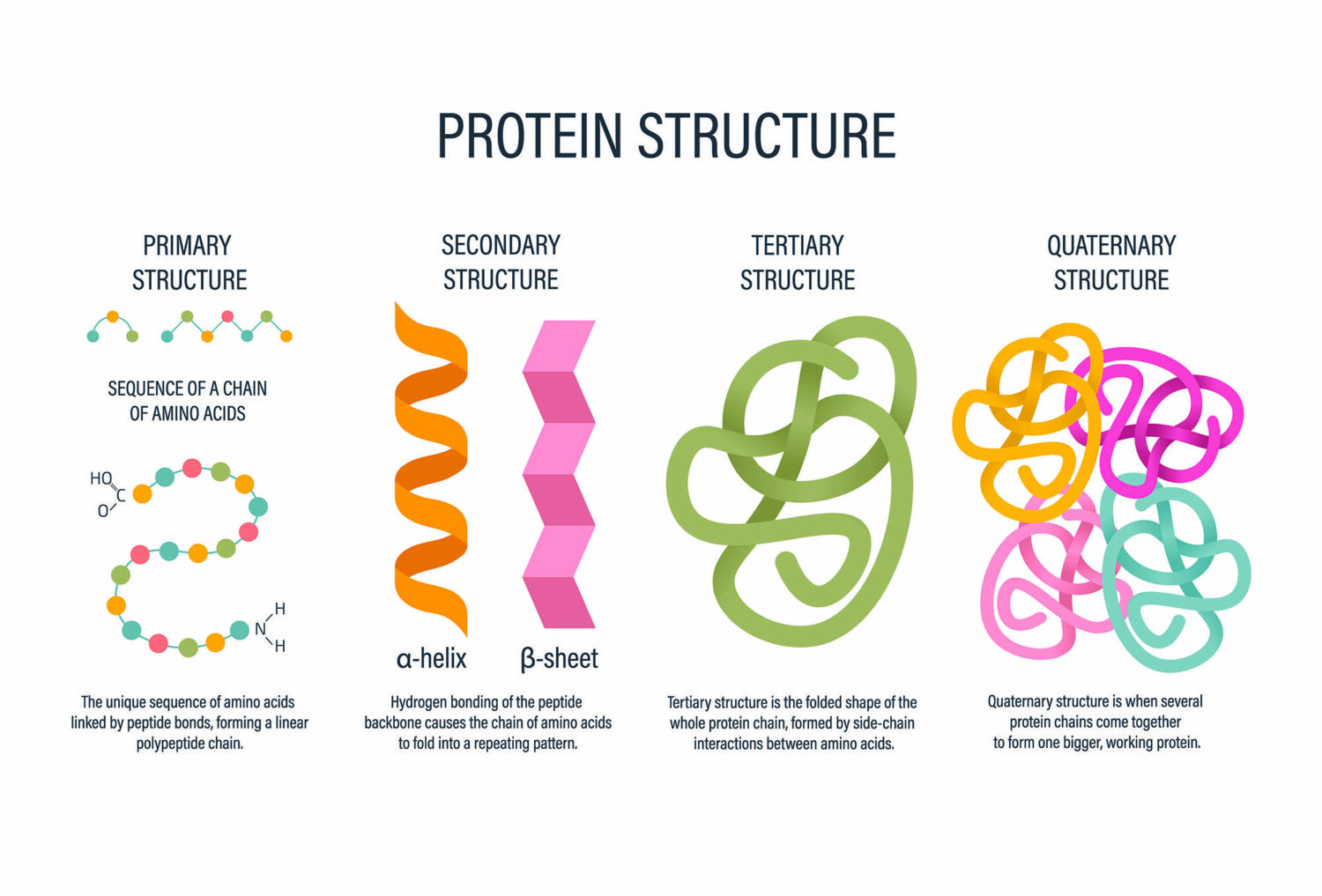
Protein characterization is the process of examining a protein to determine some key characteristics, such as how it is built and how it behaves. This includes a detailed analytical identification of functional, chemical, and physical properties and involves mapping covering everything from its three-dimensional folding and amino acid sequence to its post-translational modifications. It is a critical component of modern biological research and pharmaceutical development.
Thorough examination of a protein is necessary for drug discovery as it determines its mechanism of action, which predicts its behavior and is a big part of accessing a drug’s safety, toxicity, immunogenicity, stability, and efficacy, especially as it relates to biologic drugs. It is also a necessary part of meeting important regulatory requirements within the pharmaceutical industry.
There are several techniques used to complete the process of protein characterization, including X-Ray Crystallography, Nuclear Magnetic Resonance (NMR) Spectroscopy, and Mass Spectrometry (MS). Each of these techniques, along with their strengths and limitations, will be explored in more detail below. Protein characterization has a wide range of applications in laboratory research, biomedical research, the pharmaceutical industry, and the food industry. These techniques are used in drug discovery and development to prove biotherapeutic safety and efficacy, as well as in biotechnology, bioengineering, and the study of disease mechanisms.
Key Techniques in Protein Characterization
There is not a one-size-fits-all technique that can be applied to all protein characterization needs. This is because no single method can address all the needs scientists have to determine protein sequence, structure, function, or purity. A combination of techniques including analytical, spectroscopic, and biophysical is utilized to properly evaluate and characterize a protein. The following are the key techniques used:
- X-Ray Crystallography: This technique is utilized to discover the exact molecular and 3D atomic structure of crystalline materials. It works by directing an X-ray beam to a purified, crystallized molecule. When the X-ray hits a repeating atomic lattice, it scatters in a process called diffracting. By measuring the intensity and angles of the light as it is diffracted, a scientist can reconstruct a 3D map of the electron density.
- Strengths: This technique produces a high-resolution, highly detailed atomic map, and shows bond-length data.
- Limits: This technique requires the molecules to form well-ordered and large crystals, which can be a time-consuming and difficult process.
- Nuclear Magnetic Resonance (NMR) Spectroscopy: This technique works by exploiting the magnetic properties of specific atomic nuclei in order to understand structures. Molecules are placed in a strong magnetic field and are then subjected to radiofrequency pulses. The nucleus absorbs and then re-emits these electromagnetic waves, revealing chemical shifts through distinct frequencies. These frequencies correspond to the specific chemical environment of the atoms.
- Strengths: NMR can successfully analyze molecules in a natural solution, which allows researchers to study flexibility, molecular dynamics, and interactions as they occur within a liquid state.
- Limits: This technique is less effective for massive molecular structures. It also requires highly concentrated and relatively large samples.
- Mass Spectrometry (MS): This is another technique used in protein characterization, most often used to measure the mass-to-charge ratio of one or more molecules present within a sample. It works by turning ionized molecules into charged particles, accelerating them through electric and magnetic fields. Particles are detected and sorted, creating a spectrum that reveals the mass of the original molecule and its fragments.
- Strengths: This technique is highly sensitive, so it only requires a trace amount of a sample. It is the primary method used for identifying unknown compounds, for sequencing proteins or peptides, and for determining molecule weight.
- Limits: This technique does not provide the exact 3D spatial arrangement or geometric structures of complex molecules on its own.
Chromatography and Protein Purification Methods
Chromatography and protein purification are key parts of protein analysis and characterization. Chromatography separates and then purifies proteins based on their unique physical and chemical properties. It works by passing a mixture through a stationary phase matrix, allowing scientists to isolate target proteins. The following are primary methods used in this process:
- Ion Exchange Chromatography (IEX): This method works by separating proteins based on their net surface charge. It works by altering the pH sequentially or gradually increasing the salt concentration in order to release proteins. This is used to map post-translational modifications (PTMs), profiling charge variants and purifying proteins.
- Size Exclusion Chromatography (SEC): This methodology is used to separate proteins based on their hydrodynamic volume or molecular weight. It works because larger proteins cannot enter the porous beads in the column and elute first, while smaller proteins can enter the pores and elute later. This is the standard technique used for separating aggregates like dimers and trimers from monomers as well as estimating molecular weight.
- Affinity Chromatography: This method separates based on specific, reversible biological interactions between a ligand and protein. A bonding agent – such as a metal ion, inhibitor, or antibodies – is immobilized on the matrix. The target protein will then bind, while unbound material is washed away before the target is eluded. Affinity Chromatography is primarily used to isolate specific proteins from complex mixtures along with being used to study protein-protein interactions.
Advanced Spectroscopy and Analytical Methods
Advanced spectroscopy and analytical methods are rapid, highly precise, and nondestructive techniques used to determine material properties, molecular structures, and chemical composition as part of protein analysis and characterization. Recent innovations within this aspect of patient studies are composed of a combination of ultra-high resolution mass spectrometry, AI-assisted structural prediction, and single-molecule multiomics.
These tools have shifted the field of study from broad, exploratory analysis work to more precise, single-cell mapping of proteins and their dynamic interactions. These methods probe the interaction between matter and electromagnetic radiation and provide immediate, qualitative, and quantitative data. Overall, the pharmaceutical industry is embracing these changes and moving from batch-mode processing to continuous manufacturing, a venture that has been a joint effort spearheaded by academic groups, corporations, and government agencies.
These methods include NMR Spectroscopy, as well as other Mass Spectrometry Hyphenated Techniques to analyze protein structures; Vibrational Spectroscopy (such as IR and Raman) to identify functional groups and provide real-time chemical tracking; and chemometrics, an advanced data-processing approach that extracts meaningful information from noisy, overlapping, or multidimensional spectral data.
Bioinformatics and Computational Tools in Protein Characterization
Bioinformatics and computational tools are the foundation of modern protein characterization. They allow researchers to predict structures, model interactions, and annotate functions at high rates of speed. These technologies work with software and databases to drive modern protein research, transforming how today’s scientists design, discover, and understand proteins for applications in rapid vaccination development, synthetic biology, and targeted drug discovery. In addition, computational tools have become a vital part of protein structure prediction. Following is a closer look at some of the primary computational tools and approaches used in research today for protein structure predication and overall analysis.
- Deep Learning and AI Prediction: Modern AI tools predict protein 3D structures based on their amino acid sequences with experimental accuracy, thus allowing researchers to bypass slower, traditional methods. This includes AlphaFold, RoseTTAFold, ESMFold, OpenFold, and Chai.
- Traditional & Template-Based Modeling: These tools rely on evolutionary relationships and effectively compare new sequences to proteins with known structures. Examples of this type of modeling are:
- Swiss-Model is a widely used automated web server used to generate homology models based on template structures.
- Modeller is a foundational software program that is used for comparative modeling and homology of three-dimensional structure.
- Robetta is the web server interface for Rosetta software that can identify structural templates for comparative modeling or use de novo methods when no suitable template is available.
- Protein Analysis, Visualization, and Validation: After a structure is predicted, tools like these are used to analyze folding, dynamics, and molecular interactions. Examples include:
- PyMol is a user-assisted molecular visualization system that can be used to view, analyze, and render 3D structures of proteins and nucleic acids
- Chimera & Chimera X are visualization and analysis platforms used to explore molecular structures, interactions, and related data.
- Molecular dynamics (MD) simulation tools, such as AMBER, GROMACS, and NAMD, which model the physical movements of molecules over time to help researchers analyze protein flexibility, stability, and molecular interactions under different conditions.
Applications and Challenges in Protein Characterization
Functional assays are developed when specific protein activity is identified and protein characteristics are quantified based on binding affinity, catalytic efficiency, specificity, and stability, which are key in both basic research and drug discovery. Protein characterization enables scientists to map the function, structure, and interactions of proteins. In terms of drug development and biotechnology, the ability to identify and characterize proteins is critical for quality control, biologic drug development, and disease diagnostics. Key applications include biotherapeutic and monoclonal antibody engineering, drug target validation, quality control and regulatory compliance, biomarker discovery, and industrial biotechnology applications as part of biofuel, food, and agriculture production.
There are challenges surrounding the act of studying proteins and their modifications, including difficulties surrounding marginal thermodynamic stability of native structures along with the highly labile, heterogeneous nature of modifications. This presents itself in biophysical limits, analytical bottlenecks, and computational constraints. following is a closer look at some of these very real industry challenges:
- Marginal Thermodynamic Stability: Proteins are only marginally stable under physiological conditions. This makes them highly sensitive to minute changes in environments like salinity, pH, and temperature, which can lead to aggregation and denaturation.
- Labile Chemical Nature: PTMs like acetylation, phosphorylation, and redox states are fragile and highly reactive. This can make them easily lost or altered during sample preparation, mass spectrometry, and cell lysis.
- Low Abundance & Stoichiometry: Detecting the rare biologically relevant modifications that occur at low stoichiometry requires fractionation steps and deep enrichment, which can result in sample loss.
- In Vitro vs. In Vivo Discrepancies: Another challenge is experimental measurements that typically occur in isolated in vitro buffers but fail to replicate in complex or crowded macromolecular environments of the cell. The result is a significant alteration in protein folding or stability.
- Computational Complexity: Predicting how modifications or amino acid mutations affect overall stability relies on structural states that are immense. Generally, even current computational predictors struggle with generalization and robustness.
Protein Characterization With BA Sciences
The role that protein characterization plays in modern biological research and pharmaceutical development cannot be overstated. Advancements in methodology and applications welcome exciting new possibilities in the industry. At BA Sciences, we provide protein characterization services that accommodate regulatory requirements using established methods to ensure the identity, purity, structural, and conformational integrity along with the activity of your protein product.
We characterize proteins, identify impurities, and provide characterization with binding assays and peptide mapping analysis. These techniques work together to create a more complete understanding of protein structure, function, and regulatory compliance. Contact us today to learn how our services can support your research, development, and production goals with the accuracy and reliability your work demands.